


For amusement parks and water parks, every ticket sold marks the beginning of the guest experience. It also creates a transaction that must be accurately tracked, validated, and managed.
Yet many attractions still rely on separate systems for online ticketing, onsite purchases, and admission control. While each serves a purpose, disconnected technology can create extra steps for employees, longer queues for guests, and gaps in operational visibility.
Integrated ticketing and access control bring these processes together. Operators can simplify admissions, protect revenue, and make more informed decisions using connected sales and attendance data.
The Hidden Costs of Disconnected Ticketing Systems
Consider a family purchasing tickets online before visiting a water park. Upon arrival, they wait in line to exchange their confirmation for admission credentials. Staff manually verify the purchase, issue wristbands, and direct the family toward another checkpoint for entry.
What should be a straightforward arrival becomes a frustrating series of checkpoints, with each additional step increasing the likelihood of delays, errors or missed transactions.
These challenges become especially apparent during peak attendance periods, when seasonal parks and attractions must process large numbers of visitors within a relatively short window.
Disconnected systems can also make it difficult to determine how many tickets have been sold, how many guests have entered, and how much capacity remains available. When sales and admission records must be reconciled manually, management may lack the information needed to make timely operational decisions.
Fragmented processes can affect everything from staffing efficiency and revenue accountability to a park’s ability to maximize available capacity.
Connecting Online and Onsite Ticket Sales
These days, guests expect the flexibility to purchase tickets before arriving, upgrade their experience onsite, and move between attractions without unnecessary transactions. Delivering that convenience becomes more complicated when online ticketing, point-of-sale counters and attraction access operate independently.
An integrated platform connects these purchasing channels, helping operators maintain consistent ticket products and availability while reducing manual intervention. For parks offering multiple experiences, this connectivity is especially valuable.
“If a guest buys a card, they should be able to use it at the arcade, the rides, the water park, the go kart tracks, anywhere,” said Ken Taylor, managing director of Casino Pier & Breakwater Beach in Seaside Heights, New Jersey.
For parks offering a variety of attractions, that level of connectivity can make a meaningful difference. Guests can move between experiences without navigating separate purchasing processes, while operators maintain greater control over transactions throughout the property. More flexible ticket packages also create opportunities to capture additional revenue during a guest’s visit.
How Can Amusement Parks Reduce Entry Lines Without Adding Staff?
For amusement parks and water parks, the guest experience begins at the gate. Lengthy ticket lines, manual validation, and multiple admission checkpoints can create frustration before visitors even enter the park.
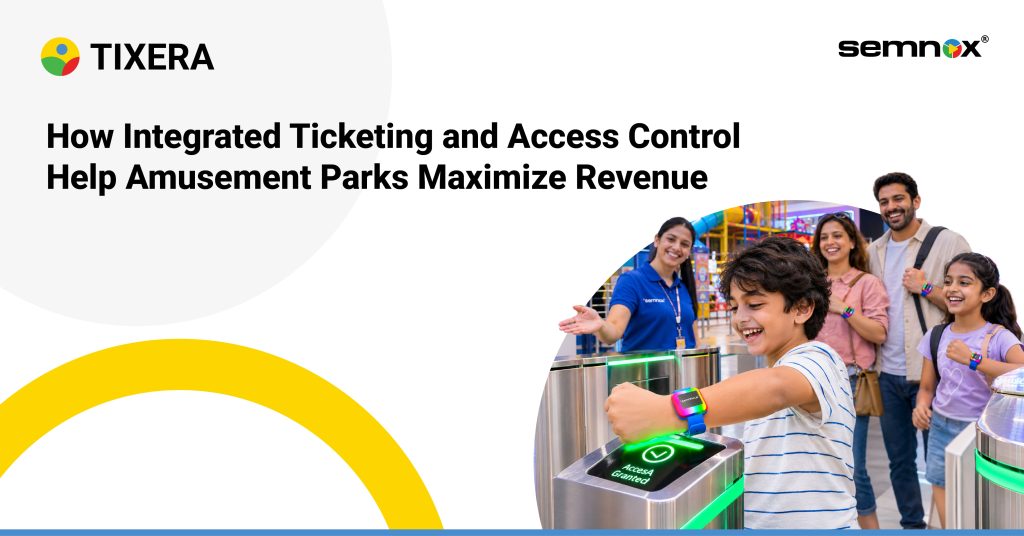
Integrated ticketing and access control help eliminate unnecessary steps by connecting ticket purchases directly to admission validation. Whether guests arrive with a QR code, barcode ticket or RFID wristband, operators can validate access through automated gates, fixed readers or mobile handheld devices.
At Jenkinson’s Boardwalk in Point Pleasant Beach, New Jersey, the transition to Semnox’s RFID technology helped eliminate frustrations associated with traditional swipe cards.
“You’d walk by and see people sliding the card back and forth to get the swipe to work,” said Vincent Storino, operations manager at Jenkinson’s Boardwalk. “That doesn’t happen with the tap.”
Combined with self-service kiosks and mobile transaction capabilities, the technology has helped Jenkinson’s minimize guest lines and provide employees with greater flexibility to assist visitors throughout the property.
With fewer routine transactions requiring staff assistance, employees have more flexibility to address guest needs elsewhere in the park. During busy periods, that can make a meaningful difference in keeping operations moving without increasing staffing demands.
Preventing Revenue Leakage Through Better Ticket Validation
Revenue leakage is not always the result of deliberate misuse. It can occur when transactions are recorded in one system but not accurately reflected in another, when tickets are validated inconsistently or when staff must manually transfer information between platforms.
For example, a ticket purchased through one channel may require manual activation in another system before it can be used. If that process is missed or completed incorrectly, the resulting discrepancy can complicate reconciliation and revenue reporting.
Integrated ticketing and access control help reduce these gaps by connecting sales transactions with admission activity.
When ticket issuance, validation, and redemption are recorded within a coordinated system, operators can more easily identify discrepancies and reconcile transactions.
Access control can also help enforce ticket validity, including applicable dates, time restrictions and permitted uses. This reduces reliance on manual judgment and provides a more consistent process across admission checkpoints.
Beyond preventing unauthorized entry, connected validation creates a more reliable record of ticket usage, giving operators greater confidence in their revenue reporting and reconciliation.
Turning Attendance Data into Better Business Decisions
One of the most valuable benefits of an integrated water park, theme park, or amusement park ticketing system is the information it provides beyond the transaction.
When ticket sales and admission activity are connected, operators gain a clearer understanding of purchasing behavior, attendance patterns, and available capacity.
A park may sell a significant number of tickets in advance, but those sales do not necessarily reflect how many visitors have arrived at a particular time. Comparing purchases with validated entries can help management better understand attendance and operational demand.
Connected reporting can provide insight into several key performance areas:
- Peak arrival periods: Identify when guests typically enter and adjust admission staffing accordingly.
- Ticket performance: Compare sales across admission types, packages, and purchasing channels.
- Capacity utilization: Understand how available admission or attraction capacity is being used.
- Guest purchasing behavior: Identify opportunities to promote upgrades, additional attractions, or bundled experiences.
- Seasonal trends: Use historical attendance and sales information to support future planning.
For parks with multiple attractions, timed activities, or distinct operating areas, this visibility becomes especially important.
Rather than relying on separate spreadsheets or delayed reports, management can use more complete operational information to make informed decisions.
What Should Operators Look for in an Integrated Park Ticketing System?
Choosing amusement park ticketing software should not just be about evaluating how quickly a system can sell or scan tickets. Operators need technology that supports their existing business while providing flexibility to introduce new attractions, products, and purchasing channels.
A connected platform should bring together online ticketing, onsite POS, self-service kiosks, access validation, and reporting. It should also accommodate the unique demands of seasonal operations and high-volume attendance.
A system that connects admission with additional revenue opportunities like food and beverage, retail and cashless transactions, can also help simplify operations while reducing the complexity of managing multiple technology providers.
Scalability also matters. As parks introduce new experiences or expand their operations, their ticketing and admission infrastructure should be able to evolve without requiring an entirely new collection of disconnected systems.
Ultimately, the right platform should support more than today’s ticket sales. It should provide the operational flexibility, reliable support and connected data needed for sustainable growth.
A More Connected Approach to Amusement Park Operations
Maximizing revenue isn’t simply about selling more tickets. It’s about reducing operational inefficiencies, making better use of available capacity and creating a guest experience that encourages visitors to explore more of what a park has to offer.
Tixera, powered by Semnox Solutions, connects online ticketing, onsite sales, self-service kiosks, cashless technology and access control within a unified platform. With integrated reporting and flexible admission management, operators gain greater visibility into their business while reducing the complexity of managing multiple systems.
From the first ticket purchase to the final attraction, a connected approach helps parks operate more efficiently and uncover opportunities for sustainable revenue growth.
Discover how Tixera can help connect your park ticketing, access control and guest experience.
FAQ’s
1. How can amusement parks reduce ticket fraud and prevent unauthorized entry?
Amusement parks can reduce ticket fraud by implementing an integrated ticketing and access control system. Tixera by Semnox supports QR code, barcode, and RFID-based ticket validation through handheld devices and automated access gates. This ensures that only valid ticket holders can enter, helping prevent unauthorized access and revenue leakage.
2. What is the best ticketing and access control system for amusement parks?
The best system combines online ticket sales, on-site POS, automated access gates, ticket validation, and real-time reporting. Tixera offers an integrated amusement park ticketing solution that connects ticket sales and admission management through a centralized platform, helping operators streamline operations and improve guest experiences.
3. How can amusement park operators track visitor attendance and ticket revenue in real time?
Amusement park operators can use centralized ticketing software with real-time dashboards and reporting features. Tixera helps operators monitor ticket sales, visitor footfall, admissions, and revenue performance across multiple sales channels, providing valuable insights for better attendance management and business decisions.
4. How does automated entry management improve revenue and operational efficiency at amusement parks?
Automated entry management uses QR codes, barcodes, RFID cards, and wristbands to validate tickets through access gates and handheld scanners. Tixera integrates ticketing with access control to speed up visitor entry, reduce manual verification, minimize ticket misuse, and improve operational efficiency during peak hours.
5. What are the benefits of using a centralized amusement park ticketing and admission management system?
A centralized ticketing and admission management system connects online bookings, on-site ticket sales, POS, access control, and reporting. Tixera brings these operations together on one platform, helping amusement parks manage visitor capacity, track attendance, simplify admissions, introduce promotional offers, and identify opportunities to increase revenue.