

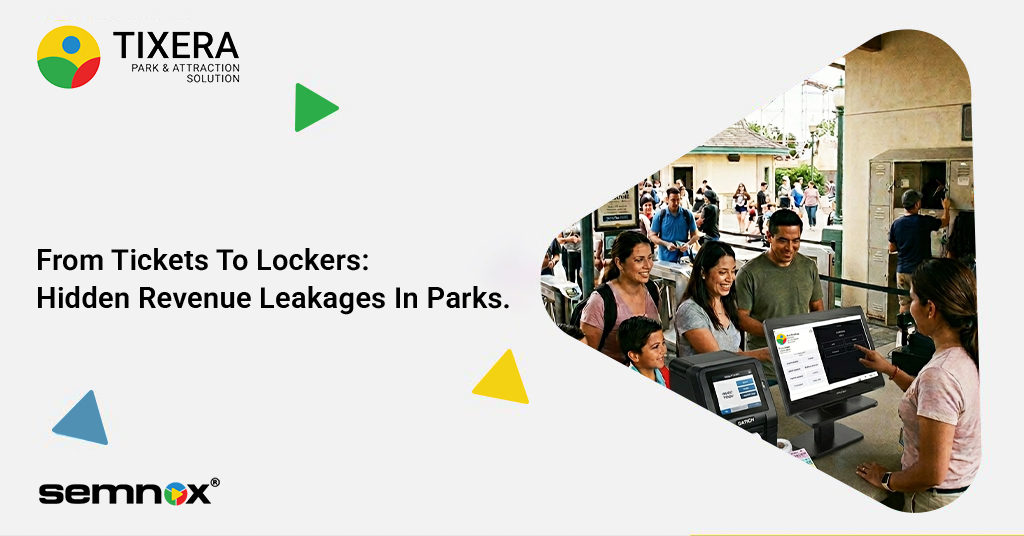
From Tickets to Lockers” Hidden Revenue Leakages in Parks.
Why a Cashless System for Amusement Parks Is No Longer Optional
It’s a busy Saturday.
Footfall is high. Rides are full. Food and beverage counters are crowded. By every visible metric, it looks like a great day.
But here is the uncomfortable truth.
Even on your best days, revenue leakage in amusement parks can quietly erode 5 to 15 percent of your earnings.
Not through major theft.
Not through system failure.
But through small, unnoticed gaps across your operations.
The Problem Most Parks DoExpanding Reach of Theme Park Ticketing Systems Not See
Most park operators track performance through surface-level metrics:
- Footfall
- Ticket sales
- Ride popularity
But very few track what actually matters most: revenue integrity across every touchpoint. Leakages rarely show up as obvious losses. That tells a different story.
Instead, they appear as missed potential, making them harder to identify and even harder to fix. A transaction that was never recorded. A ride that was triggered without payment. Inventory that does not align with sales. Individually, these issues may seem insignificant. Across an entire operation, they add up quickly.
Where Revenue Leakage Occurs Across the Park
Revenue leakage is not confined to a single department. It is distributed across the entire guest journey.
At the point of entry, manual overrides or ticket validation gaps can result in unauthorized access. Once inside, rides and games may be triggered without proper tracking, particularly in environments where manual intervention is still required.
In food and beverage operations, the absence of system controls can lead to unbilled transactions, inconsistent discounting, or inventory mismatches. Retail environments face similar challenges, where stock shrinkage and untracked sales can quietly impact margins.
Even areas that are often overlooked, such as locker systems, contribute to leakage. Without automated billing and usage tracking, these spaces represent untapped revenue rather than optimized assets.
What connects all of these scenarios is not intent, but lack of control. When systems are disconnected, there is no single source of truth.
Why Traditional Systems Fall Short
Many parks still operate on a combination of legacy systems that were implemented over time rather than designed to work together.
Ticketing systems function independently from point-of-sale operations. Ride access is often managed separately from payments. Retail, redemption, and locker systems may operate on entirely different platforms.
This fragmentation creates blind spots.
Cash dependency further compounds the issue. Without a digital audit trail, it becomes significantly harder to track discrepancies or enforce accountability. By the time reports are generated, the opportunity to correct issues in real time has already passed.
In this environment, operators are not lacking data. They lack connected, actionable insight.
The Shift from Tracking Revenue to Controlling It
For many operators, the instinctive response to revenue challenges is to focus on increasing attendance. More marketing, more promotions, more footfall.
But in many cases, the more immediate opportunity lies in optimizing what is already there.
The shift is not just toward digitization, but toward control. A cashless system for amusement park operations can be the biggest differentiator in how revenue is captured, tracked, and protected across a venue as a whole.
How an Integrated, Cashless Ecosystem Changes Operations
A unified platform like Tixera addresses these challenges by connecting every revenue-generating touchpoint within the park. Instead of managing disconnected systems, operators gain a centralized environment where ticketing, payments, retail, and operational data work together seamlessly.
Stronger control at entry
Secure validation through RFID and barcode systems reduces unauthorized access and ensures every guest interaction begins with a verified transaction.
Every ride and game becomes accountable
Automated triggers eliminate manual overrides, ensuring that every play is properly tracked and tied to revenue.
Sales and inventory stay aligned
Across food, beverage, and retail, transactions are directly connected to inventory. This creates consistency between what is sold and what is stocked, reducing discrepancies and improving visibility into performance.
Underutilized areas become revenue drivers
Locker systems, often overlooked, are transformed into structured revenue channels with digital access, automated billing, and usage analytics. What was previously unmanaged becomes measurable and optimized.
Real-time visibility replaces delayed reporting
Operators no longer rely on end-of-day or end-of-week reports. With real-time insights, anomalies can be identified as they occur, allowing for immediate action and stronger operational control.
The Measurable Impact on Park Performance
When parks transition to an integrated park management software approach, the impact is not limited to operational efficiency.
Operators often see a measurable recovery of previously lost revenue, without any increase in attendance. Per capita spend improves as friction is removed from the guest experience. At the same time, internal processes become more efficient, reducing the reliance on manual oversight.
Perhaps most importantly, decision-making becomes more informed. With access to real-time data across all departments, operators can identify trends, adjust strategies, and plan with greater confidence.
A Practical Reality Check
For operators evaluating their current systems, the most important questions are often the simplest.
- Can every transaction across the park be tracked in real time?
- Is there clear visibility into where discrepancies occur?
- Can the system actively prevent revenue loss, or only report it after the fact?
If the answers are unclear, there is likely more revenue being lost than realized.
The Bottom Line
In today’s competitive landscape, profitability is not defined solely by how many guests walk through the gate. It is defined by how effectively revenue is captured, managed, and protected once they are inside.
The challenge with revenue leakage in amusement parks is that it rarely announces itself. It exists in the background, across systems and processes that were never designed to work together. Addressing it requires more than incremental improvements. It requires a shift toward connected, cashless, and integrated operations.
Because in the end, the most significant revenue loss isn’t the one you see. It’s the one you don’t.
With a strong focus on technology-driven solutions and customer success, Harshith Ramesh plays a key role in advancing Tixera’s presence across the global attractions and leisure industry. His expertise lies in understanding operational challenges and delivering tailored solutions that drive efficiency and revenue growth.
At Tixera, Harshith works closely with amusement parks, family entertainment centers, and leisure venues to implement seamless ticketing, POS, and cashless management systems. His ability to combine technical insight with a consultative sales approach ensures clients receive scalable solutions that enhance both operational performance and guest experience.